
What Does “Blessed Are the Peacemakers” Mean?
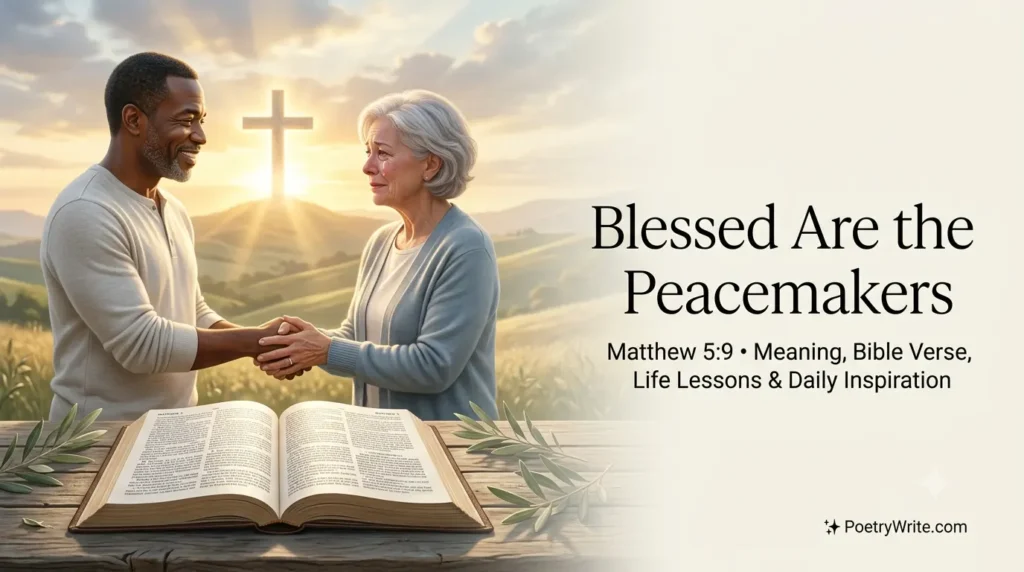
“Blessed are the peacemakers, for they will be called children of God” (Matthew 5:9) is one of the Beatitudes Jesus taught during the Sermon on the Mount. A peacemaker is someone who actively works to bring reconciliation and harmony between people in conflict. Unlike a peacekeeper who merely avoids conflict, a peacemaker takes initiative to restore broken relationships. The blessing is that peacemakers reflect God’s own character and will be recognized as His children.
At a Glance
| At a Glance | |
|---|---|
| Bible Verse | Matthew 5:9 |
| Main Theme | Peacemaking |
| Best For | Bible Study, Personal Devotion, Sermon Preparation |
| Reading Time | 10 minutes |
| Key Lesson | Reflect God’s character through active reconciliation |
Quick Navigation
Who Should Read This?
- Christians studying the Beatitudes
- Bible study groups and small groups
- Church leaders, pastors, and teachers
- Anyone seeking peace in relationships
- Readers looking for Matthew 5:9 explained in depth
- Those wanting practical steps to become a peacemaker
Key Takeaways
- Matthew 5:9 is the seventh Beatitude in Jesus’ Sermon on the Mount
- Peacemakers actively restore relationships, they don’t just avoid conflict
- Biblical peace (shalom) means wholeness, completeness, and well-being
- Jesus calls believers to reflect God’s character as peacemakers
- Peacemaking requires courage, forgiveness, humility, and love
- The reward is being called “children of God”
Quick Facts About Matthew 5:9
| Topic | Answer |
|---|---|
| Bible Verse | Matthew 5:9 |
| Speaker | Jesus Christ |
| Location | Sermon on the Mount |
| Theme | Peacemaking |
| Promise | Called Children of God |
| Testament | New Testament |
| Gospel | Matthew |
| Greek Word | Eirēnopoioi (peacemakers) |
| Hebrew Concept | Shalom (wholeness, completeness) |
If you want to explore more of Jesus’ teachings from the Sermon on the Mount, our collection of Sunday Blessings offers powerful reflections on living a life rooted in faith and grace.
Biblical Timeline
- ~27-29 AD — Jesus teaches the Beatitudes during the Sermon on the Mount
- ~50-60 AD — Matthew records the Sermon on the Mount in his Gospel
- ~30-100 AD — Early church spreads the ministry of reconciliation
- ~100 AD — Present — Christians continue applying Matthew 5:9 today
What Does “Blessed Are the Peacemakers” Mean?
Who Said This Verse?
Jesus Christ spoke these words during His famous Sermon on the Mount, recorded in the Gospel of Matthew.
Where Is It Found in the Bible?
Matthew 5:9 is the seventh Beatitude in the Sermon on the Mount (Matthew 5:3-12).
Simple Meaning for Beginners
The word “peacemaker” in Greek is eirēnopoioi—those who actively “make” or “create” peace, not just those who “love” peace or “keep” the peace. A peacemaker is an active reconciler, someone who works to restore harmony between people in conflict.
Why This Beatitude Still Matters Today
In a world filled with division, conflict, and outrage, the call to be a peacemaker is more relevant than ever. Christians are called to be agents of reconciliation—carrying the peace of Christ into their families, workplaces, communities, and social media interactions.
Matthew 5:9 Bible Verse in Popular Translations
King James Version (KJV)
“Blessed are the peacemakers: for they shall be called the children of God.”
New International Version (NIV)
“Blessed are the peacemakers, for they will be called children of God.”
English Standard Version (ESV)
“Blessed are the peacemakers, for they shall be called sons of God.”
New Living Translation (NLT)
“God blesses those who work for peace, for they will be called the children of God.”
Common English Bible (CEB)
“Happy are people who make peace, because they will be called God’s children.”
For a deeper study of Matthew 5:9 and its meaning, you can view this verse in over 200 different translations and languages on Bible Gateway, which is the most-visited Christian website in the world and serves more than 20 million people each month . They also provide helpful commentaries, reading plans, and a free Bible app to help you explore Scripture and its application in daily life
Understanding the Word “Peacemaker”
Difference Between Peacekeeper and Peacemaker
This is one of the most important distinctions to understand:
| Peacekeeper | Peacemaker |
|---|---|
| Avoids conflict at all costs | Confronts conflict constructively |
| Sweeps issues under the rug | Addresses issues honestly |
| Maintains false peace | Pursues true reconciliation |
| Passive approach | Active, intentional approach |
| May allow sin to continue | Seeks righteousness and justice |
| Avoids uncomfortable conversations | Initiates difficult conversations |
A peacekeeper avoids conflict by sweeping needed conversations under the rug and pretending everything is fine. A peacemaker, however, cares about the person and the situation enough to put time and energy into pursuing peace with others. There is intentionality and a desire for reconciliation, not avoidance.
Biblical Meaning
“Peace” in the Bible (shalom in Hebrew) means more than the absence of conflict—it means wholeness, completeness, and well-being. A peacemaker is someone who actively works to restore wholeness in relationships.
The Greek word eirēnopoioi emphasizes action and initiative. Jesus did not say “Blessed are the peacewishers” or “Blessed are the peacehopers”—peace must be made.
What Jesus Teaches
True peacemaking often comes at a cost. Jesus Himself said, “I did not come to bring peace, but a sword” (Matthew 10:34). The pursuit of true peace may sometimes create conflict because it requires confronting sin and pursuing righteousness.
Context of Matthew 5:9
The Sermon on the Mount
The Sermon on the Mount (Matthew 5-7) is Jesus’ most famous teaching, delivered to His disciples and the gathered crowd. In this sermon, Jesus describes what life in the Kingdom of Heaven looks like.
The Beatitudes Explained
The Beatitudes are eight declarations of blessing that describe the character of Kingdom citizens:
- Blessed are the poor in spirit — those who recognize their spiritual need
- Blessed are those who mourn — those who grieve over sin
- Blessed are the meek — those who are humble and gentle
- Blessed are those who hunger and thirst for righteousness — those who passionately seek God’s ways
- Blessed are the merciful — those who show compassion and forgiveness
- Blessed are the pure in heart — those whose motives are sincere and undivided
- Blessed are the peacemakers — those who actively reconcile and restore harmony
- Blessed are those who are persecuted for righteousness — those who suffer for doing right
“Matthew places this Beatitude seventh in the Sermon on the Mount, midway between inward attitudes (vv. 3-6) and outward righteousness (vv. 10-12). The order is deliberate: purity of heart (v. 8) precedes peacemaking; reconciliation with God births reconciliation with others.” ([Bible Hub][1])
How This Verse Fits with the Other Beatitudes
Rightly does this beatitude follow that of the “pure in heart,” for it is the absence of all baseness and impurity that gives the power to make peace. Only those who have experienced peace with God through Christ can become peacemakers who help others find that same peace.
Why Are Peacemakers Called Children of God?
Biblical Explanation
The promise is that peacemakers “will be called children of God.” This is not just a future title but a present reality—peacemakers are recognized as God’s children because they reflect His character.
Spiritual Significance
God is the ultimate peacemaker. He “reconciled us to Himself through Christ and gave us the ministry of reconciliation” (2 Corinthians 5:18). When we work to make peace, we are doing the work of God.
Relationship with God’s Character
- God is “the God of peace” (Romans 16:20)
- Jesus is the “Prince of Peace” (Isaiah 9:6)
- The Holy Spirit produces the fruit of peace (Galatians 5:22)
Those who actively make peace demonstrate the family likeness and are recognized as children of God.
Just as peacemakers reflect God’s heart, starting your week with intentional prayer and gratitude can help you live out this calling. Our Monday Blessings and Wednesday Blessings provide daily encouragement to walk in faith and purpose
How Jesus Was the Ultimate Peacemaker
The Cross and Reconciliation
Jesus is the ultimate peacemaker. Through His sacrificial death on the cross, He reconciled humanity to God (Ephesians 2:14-16). He broke down the dividing wall of hostility between Jews and Gentiles, creating one new humanity.
Peace with God
Before Christ, we were enemies of God. Through His sacrifice, we now have “peace with God through our Lord Jesus Christ” (Romans 5:1). This is the foundation of all peacemaking.
The Gospel Message
The gospel itself is the message of peace. Jesus came to bring good news of peace (Acts 10:36). When we share the gospel, we are participating in the greatest peacemaking work of all.
Sacrifice and Love
Jesus’ peacemaking came at great cost—His own life. True peacemaking often requires sacrifice, humility, and putting others before ourselves.
Common Mistakes Christians Make About Peacemaking
1. Avoiding Difficult Conversations
Many Christians avoid necessary confrontations because they don’t want to “cause conflict.” But true peacemaking sometimes requires difficult conversations. Avoiding issues only allows problems to grow.
2. Confusing Peace with Compromise
Being a peacemaker does not mean abandoning truth or righteousness for the sake of comfort. True peace is based on justice and truth, not on a false truce with sin.
3. Forgiving Without Healthy Boundaries
Forgiveness is essential, but it doesn’t mean pretending abuse or harm didn’t happen. Peacemakers can forgive while still maintaining healthy boundaries for safety.
4. Trying to Fix Every Conflict Alone
Some peacemakers try to fix every conflict by themselves, taking on burdens that aren’t theirs to carry. Sometimes we need to involve others or simply do our part and leave the rest to God.
5. Being a People-Pleaser
Peacemaking is not the same as people-pleasing. Peacemakers speak truth in love, even when it’s unpopular.
Avoid These Mistakes (Quick Box)
| ❌ Mistake | ✅ Better Approach |
|---|---|
| Avoiding truth to keep peace | Speak truth in love |
| Holding grudges | Forgive quickly |
| Reacting in anger | Respond with patience |
| Gossiping | Address issues directly |
| Refusing to forgive | Extend grace as Christ did |
| People-pleasing | Seek to please God first |
Can You Be a Peacemaker Without Compromising Truth?
Truth and Grace
Jesus was full of “grace and truth” (John 1:14). He never compromised truth to avoid conflict, yet He always extended grace. Peacemakers must follow His example.
Love with Honesty
Speaking the truth in love (Ephesians 4:15) is the balance Christians must strike. Peacemaking involves honesty—sometimes uncomfortable honesty—but always delivered with love and respect.
Biblical Correction
Sometimes peacemaking involves gently correcting someone who is in error. Paul wrote, “Brothers and sisters, if someone is caught in a sin, you who live by the Spirit should restore that person gently” (Galatians 6:1).
Practical Ways to Be a Peacemaker Today
At Home
- Listen before reacting
- Speak gently, even when frustrated
- Choose forgiveness over holding grudges
- Be the first to apologize
- Create a home environment of safety and respect
- Pray together during difficult times
In Marriage
- Communicate openly and honestly
- Address conflicts directly, not passively
- Seek to understand before being understood
- Forgive quickly and fully
- Make your spouse feel heard and valued
- Don’t go to bed angry (Ephesians 4:26)
At Work
- Don’t gossip or spread negativity
- Mediate conflicts between coworkers
- Treat everyone with respect
- Be a calming presence in stressful situations
- Promote collaboration over competition
- Address issues directly with the person involved
At School
- Stand against bullying
- Include those who feel left out
- Speak up for kindness
- Don’t participate in gossip or drama
- Be a positive influence on others
On Social Media
- Think before you post
- Don’t engage in online arguments
- Speak truth in love
- Avoid spreading rumors or misinformation
- Be quick to apologize if you’ve offended
- Use your platform to build up, not tear down
In Church
- Address conflicts biblically (Matthew 18:15-20)
- Pursue unity without compromising truth
- Don’t gossip or take sides
- Be quick to forgive and reconcile
- Pray for unity in your church community
- Remember that we are all one body in Christ
During Disagreements
- Listen more than you speak
- Stay calm and avoid anger
- Seek to understand the other person’s perspective
- Apologize when you’re wrong
- Focus on the issue, not the person
- Be willing to compromise when appropriate
- Don’t let pride prevent reconciliation
Real-Life Examples of Peacemaking
Family Conflicts
- Forgiving a family member who has hurt you, just as Christ forgave you
- Reconciling a relationship that has been broken by years of estrangement
- Mediating between family members who are in conflict
Friendship Restoration
- Reaching out to a friend after a painful disagreement
- Owning your part in a conflict and seeking forgiveness
- Being willing to let go of pride and take the first step toward reconciliation
Community Service
- Volunteering in organizations that promote peace, reconciliation, and justice
- Mentoring young people to resolve conflicts peacefully
- Participating in community dialogues that bring diverse groups together
Forgiveness and Reconciliation
- Choosing to forgive someone who has deeply wronged you, freeing yourself from bitterness
- Reaching out to someone who has offended you, even when you are in the right
Biblical Examples of Peacemakers
- Abraham and Lot (Genesis 13) — Abraham gave Lot first choice to avoid conflict
- Moses interceding for Israel (Exodus 32)
- Phinehas stopping the plague (Numbers 25:11-13)
- Abigail preventing bloodshed (1 Samuel 25)
- Barnabas uniting Paul with the apostles (Acts 9:26-27)
Benefits of Being a Peacemaker
| Benefit | Daily Impact |
|---|---|
| Stronger relationships | Better communication, deeper trust |
| Spiritual growth | Closer to God, Christ-like character |
| Emotional peace | Less stress, more joy |
| Community unity | Healthier families, churches, workplaces |
| Answered prayers | Unhindered relationship with God |
| Witness to others | Your life shows the gospel |
| Divine approval | You are blessed by God |
Peacemaker Checklist
- ✔ Listen before speaking
- ✔ Pray before responding
- ✔ Forgive quickly
- ✔ Speak respectfully
- ✔ Tell the truth lovingly
- ✔ Seek reconciliation
- ✔ Take the first step
- ✔ Let go of pride
- ✔ Be willing to apologize
- ✔ Extend grace to others
Bible Verses Related to Blessed Are the Peacemakers
Romans 12:18
“If it is possible, as far as it depends on you, live at peace with everyone.”
This verse shows that peacemaking requires effort on our part—we are to actively pursue peace.
James 3:18
“Peacemakers who sow in peace reap a harvest of righteousness.”
Peacemaking produces good fruit. When we sow peace, we reap righteousness and blessing.
Hebrews 12:14
“Make every effort to live in peace with everyone and to be holy; without holiness no one will see the Lord.”
This verse connects peacemaking with holiness—both require effort and are essential for the Christian life.
John 14:27
“Peace I leave with you; my peace I give you. I do not give to you as the world gives. Do not let your hearts be troubled and do not be afraid.”
Jesus gives us His peace—a peace that the world cannot offer. This peace empowers us to be peacemakers.
Philippians 4:7
“And the peace of God, which transcends all understanding, will guard your hearts and your minds in Christ Jesus.”
God’s peace guards our hearts and minds, protecting us from anxiety and fear.
Ephesians 2:14-16
“For he himself is our peace, who has made us both one and has broken down in his flesh the dividing wall of hostility.”
Jesus is our peace, breaking down barriers and creating unity.
Psalm 34:14
“Turn away from evil and do good; seek peace and pursue it.”
Peace must be actively sought and pursued.
2 Corinthians 5:18-20
“All this is from God, who through Christ reconciled us to himself and gave us the ministry of reconciliation… We are ambassadors for Christ, God making his appeal through us.”
We are called to be ambassadors of reconciliation.
Lessons Christians Can Learn from Matthew 5:9
Forgiveness
Peacemaking requires forgiveness—letting go of offenses and choosing to extend grace to others.
Humility
Peacemaking requires humility—admitting when you’re wrong and being willing to take the first step toward reconciliation.
Kindness
Peacemaking requires kindness—speaking gently and treating others with compassion.
Patience
Peacemaking requires patience—waiting for God’s timing and being slow to anger.
Love
Peacemaking requires love—putting others’ needs above your own and seeking their good.
Common Misunderstandings About This Verse
Does Being a Peacemaker Mean Avoiding Conflict?
No. Being a peacemaker does not mean avoiding conflict at all costs. Sometimes conflict is necessary. Jesus Himself brought conflict when He confronted sin and false teaching (Matthew 23). True peace is based on righteousness, not on a false truce with sin.
Can Christians Defend Truth While Making Peace?
Yes. Peacemaking does not mean compromising truth. Christians must pursue peace without abandoning righteousness. Real peace is always based on justice and truth.
Is Peace Always Possible?
No. Romans 12:18 says, “If it is possible, as far as it depends on you, live at peace with everyone.” This implies that sometimes peace is not possible because the other party refuses reconciliation. In those cases, we have done our part and can leave the rest to God.
Blessed Are the Peacemakers Quotes
Biblical Quotes
- “How beautiful upon the mountains are the feet of him who brings good news, who publishes peace, who brings good news of happiness, who publishes salvation, who says to Zion, ‘Your God reigns.'” — Isaiah 52:7
- “Seek peace and pursue it.” — Psalm 34:14
- “For he himself is our peace, who has made us both one and has broken down in his flesh the dividing wall of hostility.” — Ephesians 2:14
Inspirational Christian Quotes
- “Men cannot manufacture peace. Human plans for the purification and uplifting of individuals or of society will fail of producing peace, because they do not reach the heart. The only power that can create or perpetuate true peace is the grace of Christ.”
- “Blessed are the peacemakers, for they shall be called the children of God. The peace of Christ is born of truth. It is harmony with God.”
- “Christ’s followers are sent to the world with the message of peace. Whoever, by the quiet, unconscious influence of a holy life, shall reveal the love of Christ; whoever, by word or deed, shall lead another to renounce sin and yield his heart to God, is a peacemaker.”
Short Peacemaker Sayings
- “No Jesus, No Peace. Know Jesus, Know Peace.”
- “Peace is not the absence of conflict, but the presence of God.”
- “Peace doesn’t happen by chance—it happens by choice.”
- “A peacemaker is someone who drags combatants to the table and gives them a reason to put down their arms.”
Prayer for Becoming a Peacemaker
Morning Prayer
Lord, I come to You this morning asking You to make me a peacemaker. Fill me with Your peace so that I can share it with others. Help me to be quick to listen, slow to speak, and slow to become angry. When conflicts arise today, give me wisdom to respond with grace and love. Help me to be an agent of reconciliation in my home, my workplace, and my community. May others see Christ in me and be drawn to Your peace. In Jesus’ name, Amen.
Prayer During Conflict
Father, I am in the middle of a difficult situation. I need Your wisdom and guidance. Help me to see this conflict through Your eyes. Give me the courage to speak truth in love and the humility to apologize when I am wrong. Show me the path to reconciliation. I surrender this situation to You and ask for Your peace to rule in my heart. In Jesus’ name, Amen.
Prayer for Family Peace
Lord, I pray for peace in my home. Heal every broken relationship and restore harmony among my family members. Help us to forgive one another as You have forgiven us. Remove bitterness, pride, and selfishness from our hearts. Fill our home with Your love and Your peace. May we be a testimony of Your reconciling power. In Jesus’ name, Amen.
If you are looking for more ways to invite God’s peace into your daily life, explore our Good Morning Blessings and Family Blessings for prayerful encouragement and spiritual strength
Daily Affirmations Inspired by Matthew 5:9
Positive Affirmations
- I am a peacemaker because God has made peace with me.
- I choose to pursue peace in all my relationships.
- I am a child of God, and I reflect His character.
- I will listen before I speak and love before I judge.
- I am an agent of reconciliation in a divided world.
- I extend forgiveness because I have been forgiven.
- I am not a peacekeeper who avoids conflict—I am a peacemaker who seeks restoration.
Faith Declarations
- God’s peace guards my heart and mind.
- The Holy Spirit empowers me to be a peacemaker.
- I am not defined by conflict—I am defined by Christ’s peace.
- Peace follows me because I follow the Prince of Peace.
- I am a blessing of peace to everyone I meet today.
Reflection Questions
- Am I bringing peace or division to the people around me?
- Is there someone I need to forgive today?
- Where can I actively build peace in my family, workplace, or community?
- How does Jesus want me to respond to the conflicts I’m currently facing?
- Am I a peacekeeper who avoids conflict or a peacemaker who seeks reconciliation?
- What one relationship can I take a step toward healing this week?
People Also Ask
What is the deeper meaning of Matthew 5:9?
The deeper meaning is that peacemakers reflect God’s own character. God is the ultimate peacemaker who reconciled us to Himself through Christ. When we actively pursue peace, we demonstrate that we are children of God and participate in His work of reconciliation. ([Bible Hub][1])
Why did Jesus bless peacemakers?
Jesus blessed peacemakers because they reflect the heart of God. God is a God of peace, and those who make peace show they belong to His family. The blessing is both present (identity as children of God) and future (public recognition at the consummation of the kingdom).
Is a peacemaker the same as a peacekeeper?
No. A peacekeeper avoids conflict and maintains a false peace, while a peacemaker actively seeks reconciliation and true harmony. Peacekeepers sweep issues under the rug; peacemakers address issues constructively. Jesus calls us to be peacemakers, not just peacekeepers.
What does “children of God” mean in Matthew 5:9?
“Children of God” means that peacemakers are recognized as part of God’s family. They reflect His character and participate in His work. This is both a present reality and a future promise—currently, we are God’s children, and in the future, this identity will be publicly affirmed.
How can Christians become peacemakers today?
Christians can become peacemakers by: receiving peace with God through Christ, allowing the Holy Spirit to transform their character, actively seeking reconciliation in relationships, being humble and willing to apologize, speaking truth in love, and pursuing peace in every area of life (family, work, church, and community).
Why did Jesus bless peacemakers?
Jesus blessed peacemakers because they reflect the heart of God. God is a God of peace, and those who make peace show they belong to His family. The blessing is both present (identity as children of God) and future (public recognition at the consummation of the kingdom).
Is a peacemaker the same as a peacekeeper?
No. A peacekeeper avoids conflict and maintains a false peace, while a peacemaker actively seeks reconciliation and true harmony. Peacekeepers sweep issues under the rug; peacemakers address issues constructively. Jesus calls us to be peacemakers, not just peacekeepers.
What does “children of God” mean in Matthew 5:9?
“Children of God” means that peacemakers are recognized as part of God’s family. They reflect His character and participate in His work. This is both a present reality and a future promise—currently, we are God’s children, and in the future, this identity will be publicly affirmed.
How can Christians become peacemakers today?
Christians can become peacemakers by: receiving peace with God through Christ, allowing the Holy Spirit to transform their character, actively seeking reconciliation in relationships, being humble and willing to apologize, speaking truth in love, and pursuing peace in every area of life (family, work, church, and community).
Final Bible Challenge
“Today, choose one relationship where you will become the first person to pursue peace. Take the first step—send the text, make the call, offer the apology, or extend the forgiveness. Be the peacemaker.”
Frequently Asked Questions
What does “Blessed Are the Peacemakers” mean?
“Blessed are the peacemakers” means that those who actively work to reconcile people and restore harmony are blessed by God. Peacemaking involves more than avoiding conflict—it means taking initiative to bring wholeness to broken relationships. Peacemakers reflect God’s character and will be recognized as His children.
Who are peacemakers in the Bible?
Peacemakers include Jesus, the Prince of Peace, who reconciled God and humanity (Ephesians 2:14-18); the apostles who preached the gospel of peace (Acts 10:36); and all believers who carry the message of reconciliation to others (2 Corinthians 5:18-20). In the Old Testament, Aaron was known as a peacemaker who loved peace and pursued it.
Why are peacemakers blessed?
Peacemakers are blessed because they reflect God’s character. God is the God of peace, and when we make peace, we demonstrate that we are His children. The blessing also includes the promise that they “shall be called children of God”—a recognition of their identity and relationship with God.
What is the reward for peacemakers?
The reward for peacemakers is that they “will be called children of God.” This promise includes both present and future aspects: currently, peacemakers reflect God’s character, and in the future, their relationship with God will be publicly affirmed.
How can I become a peacemaker?
You can become a peacemaker by:
- Receiving peace with God through faith in Christ (Romans 5:1)
- Allowing the Holy Spirit to transform your character (Galatians 5:22-23)
- Actively seeking reconciliation in your relationships
- Being humble and willing to apologize
- Speaking truth in love (Ephesians 4:15)
- Pursuing peace in every area of your life
Is Matthew 5:9 one of the Beatitudes?
Yes, Matthew 5:9 is the seventh Beatitude in the Sermon on the Mount (Matthew 5:3-12). It follows “Blessed are the pure in heart” and precedes “Blessed are those who are persecuted for righteousness.”
What Bible verse talks about making peace?
Matthew 5:9 is the primary verse about making peace: “Blessed are the peacemakers, for they will be called children of God.” Other related verses include Romans 12:18 (“If it is possible, as far as it depends on you, live at peace with everyone”) and Hebrews 12:14 (“Make every effort to live in peace with everyone”).
How is a peacemaker different from a peacekeeper?
A peacekeeper avoids conflict and pretends everything is fine, while a peacemaker actively seeks reconciliation. A peacekeeper maintains a false peace, while a peacemaker pursues true and lasting peace. Jesus calls His followers to be peacemakers, not just peacekeepers.
References
- BibleGateway — Multiple translations and commentary
- Bible Hub — Original language tools and cross-references
- GotQuestions — Supplementary explanations
- Blue Letter Bible — Lexicon and word studies
- Logos Bible Software — In-depth biblical resources
Final Thoughts
“Blessed are the peacemakers, for they shall be called the children of God.”
This Beatitude calls us to nothing less than active participation in God’s own work. The world is filled with division, hostility, and conflict. But as children of God, we are called to be agents of reconciliation—to carry the peace of Christ into every relationship and situation.
Peacemaking is not passive. It requires courage, humility, forgiveness, and sacrifice. It often means taking the first step, bearing the cost, and persevering through difficulty. But the blessing is sure: peacemakers will be called children of God.
Today, ask yourself: Am I a peacekeeper or a peacemaker? Do I avoid conflict, or do I actively pursue reconciliation? Do I sweep issues under the rug, or do I work to restore broken relationships?
May we all be counted among the peacemakers who reflect our Father’s heart of love and reconciliation.
Related Posts

“Bless the Lord Oh My Soul” Text: The Complete Guide to Psalm 103:1
The complete text of "Bless the Lord, Oh My Soul"…

Blessed Upgrade Scroll: Complete Latest Guide to Safe Upgrades
Upgrading your best gear should feel exciting, not terrifying. But…