
Do you dream of sitting in front of a crackling fire on a cold winter evening, but live in an apartment or a rented house without a chimney? You are not alone. Millions of homeowners and renters across the UK, US, Canada, and Australia face the same problem. The solution is zimmerkamine – a new generation of indoor fireplaces designed to work without any flue or structural changes. In this complete guide, you will learn about the five main types (bioethanol, electric, water vapour, gel, and pellet), their pros and cons, safety rules you must follow, country‑specific regulations, running costs, and expert buying tips. By the end, you will know exactly which zimmerkamine is right for your home

Quick Navigation
Zimmerkamine – The Beautiful Experience of Real Fire at Home Without a Chimney
Do you also dream of sitting in front of a fireplace on a cold winter evening? But an apartment or rented house has no chimney? Don’t worry. Zimmerkamine is the modern solution that gives you the same fireplace atmosphere at home without a chimney, without construction changes, and without any permission.
Zimmerkamine is a combination of two German words: Zimmer (room) + Kamin (fireplace). That is, a “room fireplace”. It is an independent fireplace that can be placed in the middle of a room or against a wall. It does not require a chimney. Let’s learn in detail about its types, safety, and how it is used in different countries around the world.
The Five Main Types of Zimmerkamine (With Pros & Cons)
Each type has its own advantages and disadvantages. The right choice depends on your needs.
1. Bioethanol Zimmerkamine
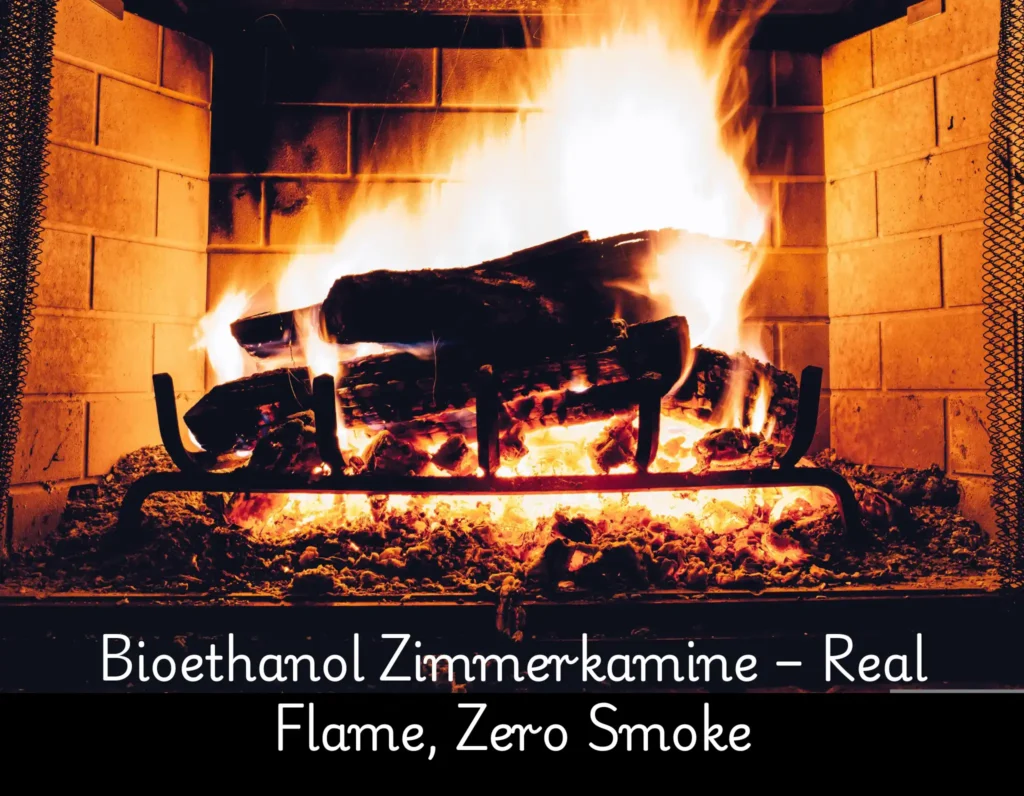
This is the most popular type. It runs on bioethanol fuel made from plants. When burning, there is no smoke, no ash, no odor. The flames are real.
- Pros: Real fire, no chimney needed, eco-friendly, can be placed anywhere in the room.
- Cons: Does not heat the room much (only 2-3 kW), fuel is expensive (€2-4 per hour), a window must be opened.
2. Electric Zimmerkamine
This electric type is the safest. It creates a flame effect using LED lights. Some models also have a heater.
- Pros: Completely safe (for children and pets), no ventilation needed, plug‑and‑play, the heater can warm a room.
- Cons: Flames are not real, electricity bill may increase.
3. Water Vapour Zimmerkamine
This creates three‑dimensional (3D) flames using water vapour and LED lights. The flames look so realistic that they are hard to distinguish from real fire.
- Pros: Extremely realistic, completely cool flames (no burn risk), best for children.
- Cons: Expensive (€400 to €2,500+), requires refilling distilled water.
4. Gel Zimmerkamine
Fuel comes in gel form, pre‑packaged in tins. No risk of spillage.
- Pros: Easy to use, no liquid to spill.
- Cons: Expensive (€2.5-5 per hour), less beautiful flames.
5. Pellet Zimmerkamine
This burns small wooden pellets. It does require a chimney.
- Pros: Can heat an entire house, very efficient (over 80% efficiency).
- Cons: Chimney required, heavy installation, expensive (€3,000-8,000).
Why Is a Zimmerkamine Better Than a Traditional Fireplace?
- Easy installation: A traditional fireplace needs bricks, a chimney, and thousands of euros. A zimmerkamine is simply taken out of the box and placed.
- Low running cost: Electric models cost 45-55 cents per hour (heater on).
- Safety: Electric and water vapour models are completely risk‑free.
- Space saving: Ideal for small flats and rented homes.
- Portable: You can move it to another room whenever you want.
Safety Measures – Avoid Fatal Mistakes (For Bioethanol & Gel)
Expert advice: “Bioethanol is an extremely flammable substance. Keep it out of children’s reach and never pour it into a hot fireplace. A small negligence can burn down your entire house.”
- Ventilation: Keep a window or door open whenever the fire is burning. Otherwise CO₂ will increase in the room.
- Wait for cooling: Wait at least 15 minutes before refilling and make sure the fire is completely extinguished.
- Safe distance: Keep a clear space of 80-100 cm around the fireplace. Keep curtains, furniture, and paper away.
- Children and pets: If you have small children, buy electric or water vapour instead of bioethanol.
- Carbon monoxide detector: Mandatory for wood or pellet fireplaces.
Country‑Specific Regulations (UK, US, Canada, Australia)
If you live in or write for these countries, this information is very important.
United Kingdom
- Bioethanol and electric zimmerkamine are fully legal.
- Building Regulations Part J requires room ventilation.
- New standard BS EN 16647-1:2025 ensures safety of sold units.
- Fuel cost: £15-20 per litre (premium brands).
- Popular retailers: Wayfair UK, Cast Fireplaces.
United States
- No specific federal laws, but local building codes may apply.
- UL or ETL certification is mandatory for electric models.
- For bioethanol, buy safety‑certified units.
- Where to buy: Amazon, Wayfair, EcoSmart Fire.
Canada
- Mandatory safety standard: All bioethanol fireplaces must be ULC/ORD-C627.1 certified.
- Storing more than 10 litres of bioethanol fuel in a home is generally prohibited.
- Popular distributors: Art Fireplace, Ecoflame.
Australia
- The strictest regulations in the world.
- Every zimmerkamine must weigh at least 8 kg and have a footprint of no less than 900 cm².
- The goal is to prevent small tabletop burners.
- Fuel cost: A$15-25 per litre.
- Sellers: EcoSmart Fire Australia, Real Flame Australia.
Zimmerkamine Cost and Maintenance
| Type | Price (USD/Euro) | Running Cost per Hour | Maintenance |
|---|---|---|---|
| Electric (basic) | $50-100 | $0.03-0.08 (no heater) | Dust only |
| Electric (with heater) | $150-400 | $0.45-0.55 (heater on) | Clean vents |
| Bioethanol | $200-600 (standard) | €2-4 | Wipe burner with damp cloth |
| Water vapour | $400-2,500 | Only electricity (very low) | Refill distilled water |
| Pellet | $3,000-8,000 (unit only) | $0.50-1.50 | Annual sweeping, check gasket |
Frequently Asked Questions (FAQs)
Q: Does a zimmerkamine need a chimney?
A: No. That is its biggest advantage. Bioethanol and electric do not need a chimney. Only pellet and wood‑burning ones need a chimney.
Q: Can I use a bioethanol zimmerkamine in a rented flat?
A: Yes, because it requires no installation. However, do check your rental agreement.
Q: Can it heat a room?
A: Bioethanol only warms you when sitting close. An electric model with a heater can warm a room of 15‑20 square metres.
Q: Does bioethanol produce carbon monoxide?
A: Very little. But it consumes oxygen and produces CO₂, so ventilation is essential.
Q: Is a zimmerkamine expensive?
A: The starting price can be as low as $50 and go up to $2,500.
Q: Does Germany’s BImSchV 2025 regulation apply to it?
A: No. That law applies only to wood and coal burning fireplaces. Bioethanol and electric are outside its scope.
Expert Tips
“Before buying a zimmerkamine, always assess your room size, presence of children, and ventilation. A cheap electric model can be safer than bioethanol if you cannot strictly follow safety guidelines.” – Ahmed Raza, Interior Designer
Where to buy?
- Global: Amazon (use your country’s site), Wayfair
- United Kingdom: Cast Fireplaces, Direct Fireplaces
- United States: EcoSmart Fire, Amazon US
- Canada: Art Fireplace, Canadian Tire
- Australia: EcoSmart Fire Australia, Real Flame Australia
Conclusion
Your dream of a fireplace at home can now become a reality. A zimmerkamine is the modern solution that will bring warmth, beauty, and peace to your life. But for the right choice, keep the following in mind:
- Want real flames and can follow safety? → Bioethanol
- Have children or pets at home? → Electric or Water Vapour
- Only want ambiance and beauty? → Electric (no heater) or Water Vapour
- Need to heat the whole room? → Pellet (with chimney)
- Cheapest and easiest solution? → Electric
Remember: Follow safety instructions, ensure ventilation, and read your country’s regulations. Don’t delay any longer – gift your home a beautiful zimmerkamine.
Related Posts

100+ Deep Sad Quotes In Urdu Text About Life
Life Quotes in Urdu In This Blog I will Publish…
Complete Guide Prime Minister’s Fan Replacement Program 2025: Stay Cool, Save More –
Are you tired of brutal summer heat and even more…

Ramzan Nigehban Card 2026: Complete Guide – Punjab Government’s Rs 10,000 Gift
Ramadan 2026 is approaching, and due to rising inflation, it…